Once You've Swum in Tayrona, Every Other Beach Feels Like a Screensaver
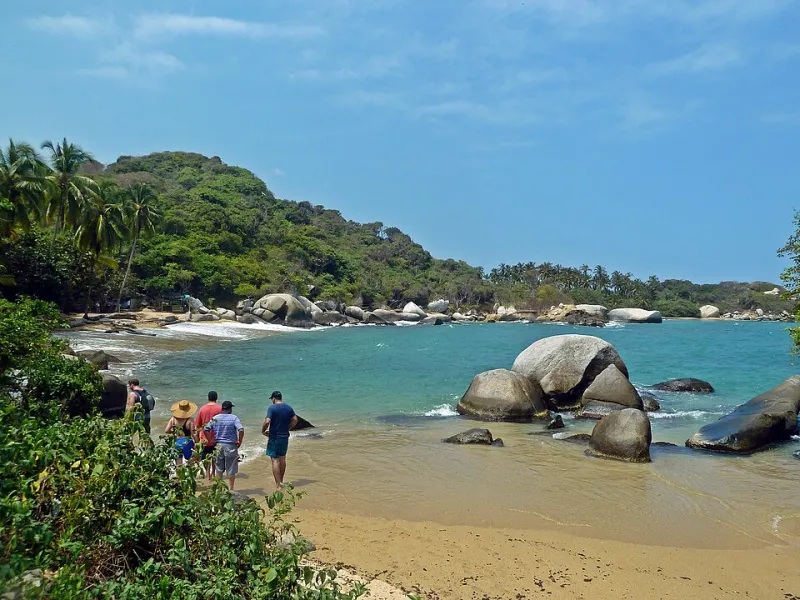
Photo: David Shankbone, CC BY-SA 3.0, via Wikimedia Commons
Sarah Kowalski did everything right. After her first trip to Colombia, she booked a "recovery" vacation in Tulum — a place that had been on her bucket list for years. She got the overwater bungalow. She did the cenotes. She ate the tacos.
"I kept waiting to feel it," she told us, sipping coffee in her Chicago apartment. "That thing. And it just never came."
She'd been to Tayrona six months earlier.
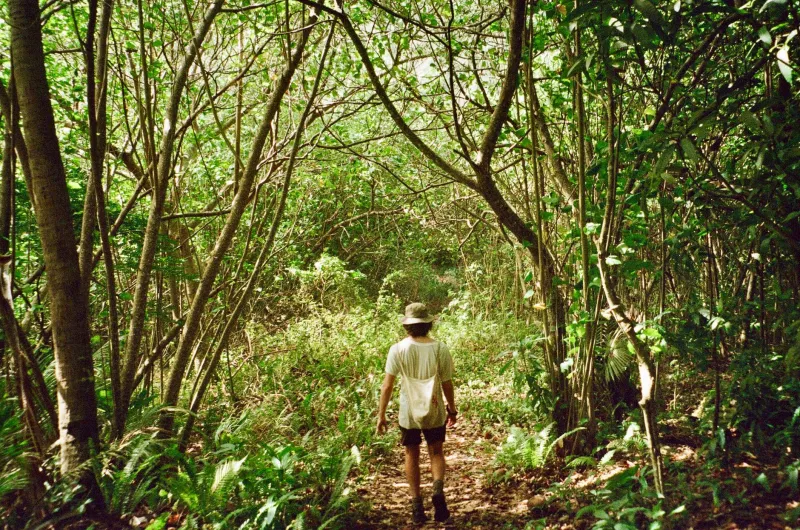
If you've spent real time inside Tayrona National Park — hiking through jungle so dense it blocks the noon sun, stumbling onto beaches where the forest crashes directly into the Caribbean without so much as a parking lot in between — you already know where this is going. There's something the park does to you that doesn't fully reveal itself until you're somewhere else, somewhere objectively beautiful, wondering why you feel vaguely cheated.
Travel people have started calling it the Tayrona Effect. And it's more common than you'd think.
What the Park Is Actually Doing to Your Brain
Dr. Michael Torres, a travel psychologist based in Miami who has studied the emotional aftermath of transformative travel experiences, has a clinical term for what Sarah and thousands of other Tayrona visitors are describing: "peak experience displacement."
"When we have an experience that engages all of our senses simultaneously — physical challenge, visual beauty, genuine unpredictability — our brain essentially recalibrates its baseline for what 'meaningful' looks like," Torres explains. "After that, experiences that are simply pleasant can feel almost hollow by comparison."
Tayrona hits almost every sensory trigger at once. The hike in isn't optional — you earn the beaches with your legs, which means your body is already primed and your brain is flooded with endorphins before you even see the water. The jungle is genuinely alive around you. Howler monkeys announce themselves from the canopy. Iguanas cross the trail without acknowledging your existence. The air smells like wet earth and salt simultaneously.
And then the beach appears between the trees, and it's not a beach — it's a revelation.
No resort. No jet ski rental hut. No DJ booth. Just rocks, palms, water in four shades of blue, and the sound of waves that have been doing exactly this for longer than anyone's been around to hear them.
"The brain logs that as significant," Torres says. "And significance is a hard thing to replicate."
The Repeat Visitor Problem
For many people, the solution to the Tayrona Effect is obvious: just go back.
And people do. Talk to enough travelers who've visited the park and you start noticing a pattern — it's rarely a one-time thing. James and Marta Delgado, a couple from Austin who discovered Tayrona on their honeymoon, have returned four times in seven years.
"We've tried other places," Marta admits. "Costa Rica, Belize, even Thailand. And look — those are all beautiful. We're not complaining. But there's always a moment where one of us looks at the other and says, 'It's not Tayrona, is it?'"
James laughs. "It's become a thing. Like a curse we gave each other as a wedding gift."
This kind of destination loyalty is well-documented in travel psychology, but Tayrona seems to generate it at an unusual rate. Part of the reason, Torres suggests, is that the park resists commodification in a way that most popular destinations don't.
"When a place stays genuinely wild — when the experience is never fully controlled or packaged — it maintains its ability to surprise you," he says. "Tayrona is different every time because nature is different every time. That's rare."
The Ethical Wrinkle
Here's where things get complicated. Because the Tayrona Effect isn't just a personal quirk — it has real implications for how people travel and where tourism dollars flow.
If Tayrona has permanently elevated your threshold for what makes a beach worth visiting, there's a good chance you're now actively seeking out destinations that share its qualities: limited development, ecological integrity, a sense of genuine discovery. That's not a bad impulse. But it also means more pressure on exactly the places that are still wild enough to satisfy the craving.
Some travelers, aware of this tension, have started making deliberate choices about how frequently they return to Tayrona specifically because they don't want to love it to death. Others have channeled the feeling into supporting conservation efforts in the region.
Sarah, for her part, has made peace with the paradox in her own way.
"I stopped trying to replace it," she says. "Now I just travel differently. I look for the edges of places — the parts that haven't been cleaned up yet. Tayrona taught me what to look for."
What to Do With the Feeling
If you've already been to Tayrona and you're nodding along to all of this, here's the practical reality: you're probably not going to un-ring that bell. The beach you loved before Colombia is still a perfectly good beach. Your brain just knows more now.
But that knowledge is actually useful. It means you've developed a genuine sense of what matters to you in a travel experience — physical engagement, ecological authenticity, the absence of infrastructure designed to make you forget you're somewhere real. That's a filter, not a sentence.
Use it. Seek out places that earn their beauty the same way Tayrona does — through effort, through wildness, through the fact that they could disappear if we're not careful.
And maybe, eventually, book the flight back to Santa Marta.
You know you want to.