Broke in the Best Way: How Traveling on Almost Nothing Around Tayrona Leads to the Trips That Actually Matter
Let's be honest about something. The luxury travel industry has done an incredible job of convincing Americans that comfort equals quality — that the more you spend, the more you get. And in some corners of the world, that's vaguely true. In Tayrona and along Colombia's Caribbean coast, it's almost entirely backwards.
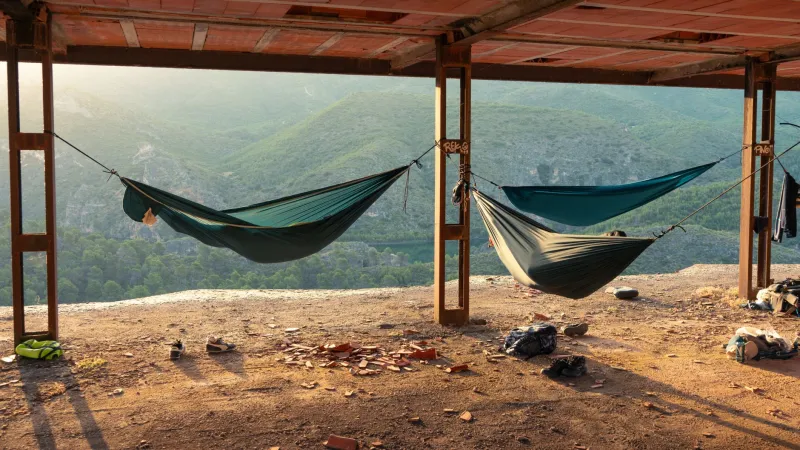
The most expensive version of this trip puts you in an eco-lodge with air conditioning, a curated breakfast buffet, and a private guide who keeps you safely insulated from anything unscripted. The cheapest version puts you in a hammock in the jungle, eating fish someone pulled from the water two hours ago, getting directions from a farmer who doesn't speak English and doesn't need to. One of these experiences is better. It's not the expensive one.
What Money Buys You (And What It Costs You)
High-end travel in Tayrona buys you certainty. You know where you'll sleep. You know the food won't make you nervous. You know someone will handle the logistics. That's real, and if you're traveling with kids or on a tight schedule, it matters.
But certainty is also the thing that keeps you inside the tourist bubble. When you've already paid for a package, you follow the package. You don't wander into the small restaurant without an English menu because you've got a reservation somewhere else. You don't end up at a stranger's kitchen table because you were lost and they invited you in. You don't spend three hours watching a family prepare sancocho because you weren't in a hurry to get anywhere.
Budget travel, done right, removes the schedule that keeps you from any of that.
The Practical Reality of Going Cheap Near Tayrona
Here's what traveling on a genuine shoestring actually looks like in this part of Colombia, with some numbers so you can calibrate.
Accommodation: Hammock camping inside the park runs roughly $15–20 USD per night and includes access to facilities. Outside the park, small guesthouses in towns like Palomino or Minca charge $10–20 for a private room. Hostels with dorm beds can go as low as $8. None of these options are miserable. Several are genuinely wonderful.
Food: The standard meal at a local corrientazo — a set lunch with soup, protein, rice, beans, and juice — costs between $3 and $5 USD. Street food is cheaper. If you're near the coast, fresh fish is almost always available at prices that would embarrass any American seafood restaurant. A full meal for two at a family-run place, with drinks, rarely exceeds $12.
Transport: Shared minivans and buses connect Santa Marta to the park entrance and to surrounding towns for $2–5. Mototaxis fill the gaps. Once you learn the rhythm of local transport — which takes about a day — you almost never need to pay for private rides.
Total daily budget for a comfortable, well-fed, non-miserable experience: $30–45 USD. Less if you're disciplined. More if you want to.
The Part Nobody Tells You About Traveling Cheap Here
When you're not spending money on insulation, you end up relying on people. And relying on people is how you actually meet them.
You ask the woman selling fruit outside the park entrance where to eat because you can't afford the restaurant with the tourist menu. She sends you to her cousin's place two blocks off the main road. The cousin's place has no signage and serves the best patacones you've ever had. You eat there every day for the rest of your trip. By day three, they know your name.
This is not a story about poverty tourism or romanticizing someone else's economic reality. It's a story about what happens when you stop using money to manage distance between yourself and the place you're visiting.
Wildlife Is Free. Seriously.
One of the great ironies of expensive Tayrona tours is that they don't actually get you closer to the wildlife — the park's most extraordinary feature. Howler monkeys don't care about your tour package. The Jesus Christ lizards running across the trail don't check your booking confirmation. The iguanas sunning themselves on rocks near Arrecifes are available to anyone walking past.
The same goes for the birds. The Caribbean coast around Tayrona is absurdly rich in birdlife — toucans, tanagers, herons, frigatebirds — and all of it is visible from public trails, public beaches, and the edges of the small farms and villages surrounding the park. A decent pair of binoculars costs less than one night at an eco-lodge. The return on investment isn't close.
A Manifesto, Sort Of
The argument here isn't that you should be miserable to prove something. It's that the version of Tayrona and the Caribbean coast that most Americans pay to avoid — the version without air conditioning and on-demand translation and curated experiences — is the version that's actually wild. Actually Colombian. Actually worth traveling 2,500 miles for.
The park is extraordinary. The coast is extraordinary. But they're most extraordinary when you're in them, not watching them from behind a buffer of comfort.
Go broke. Go slow. Eat what's in front of you. Ask where to go instead of Googling it. Get a little lost.
That's the trip that stays with you. And it costs less than you think.